


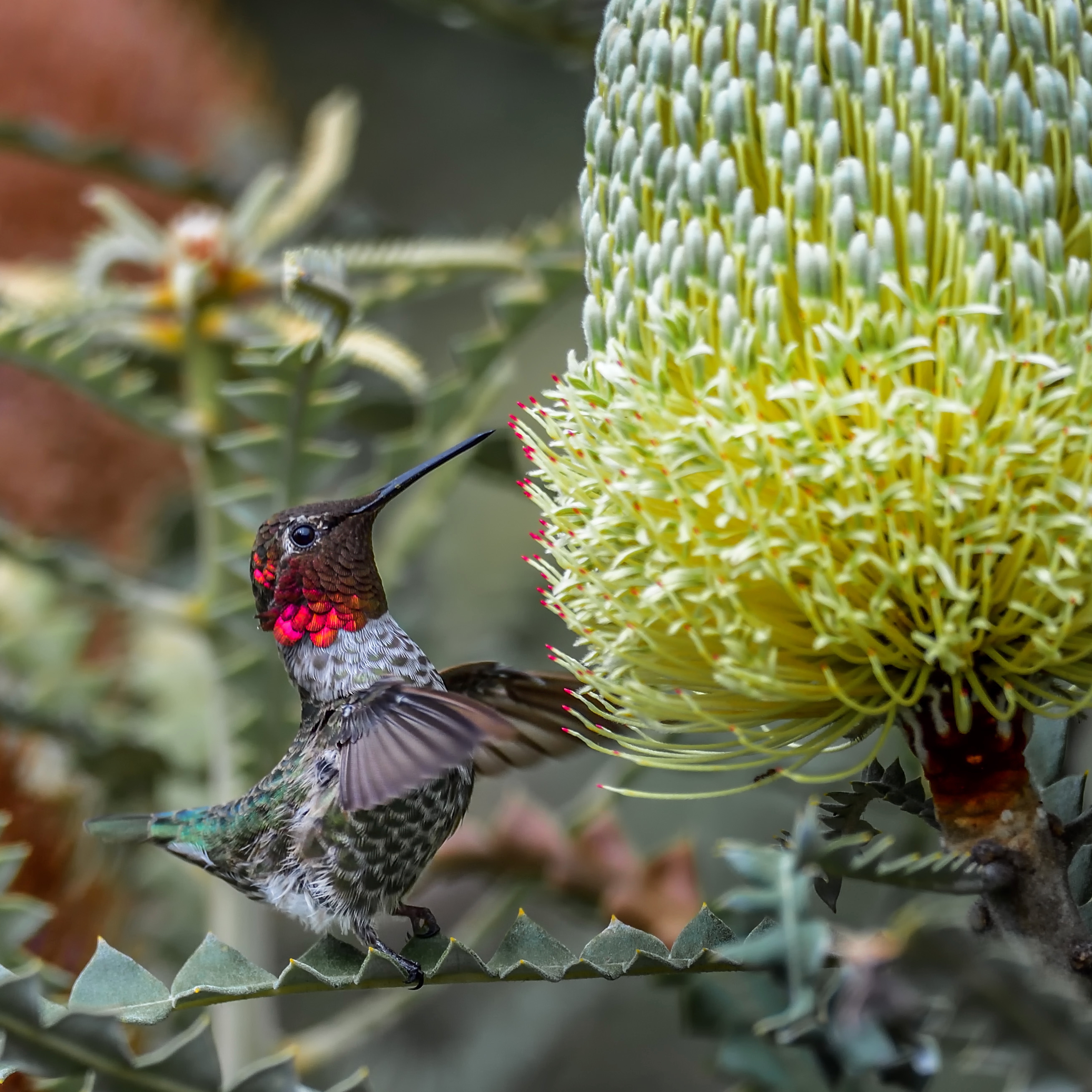


One of nature’s fascinating aspects in the garden is the flight of hummingbirds.
The UC Santa Cruz Arboretum & Botanic Garden is featuring these avian phenomena during Hummingbird Month, which started Sunday.
Brief notes on hummingbirds
The Hummingbird Month schedule includes presentations by experts and skilled photographers.
Here are info bits about these unique birds, drawn from an exceptionally long article on Wikipedia, and other sources.
Hummingbirds are native to the Americas and comprise the biological family trochilidae, which includes 375 species and 113 genera.
Fifteen species of North American hummingbirds inhabit the United States and Canada. The prominent hummingbird species seen at the arboretum and the Monterey Bay area are Anna’s (Calypte anna) and Allen’s (Selasphorus sasin).
The generic name for Anna’s hummingbird might come from the Ancient Greek word for “headdress,” and the specific name honors Anna d’Essling, the wife of ornithologist François Masséna.
Anna’s are native to western North America. While other North American species migrate from Mexico to Canada, Anna’s hummingbird is acclimated to colder winter temperatures and has a year-round residence in the Pacific Northwest. During cold weather, they might remain in torpor for extended periods.
Anna’s, like other hummingbird species, feed on nectar from flowers, small insects and other arthropods (invertebrates).
In flight, hummingbirds beat their wings in a figure-eight pattern, allowing them to suspend above the flowers on which they are feeding. Most flowers do not provide a feeding perch. Their flying ability allows flying forward, backward and even upside-down. They beat their wings 80-90 times per second. This unique flying action burns a lot of energy, requiring the birds to perch high in trees between meals.
Visiting the arboretum
The UCSC Arboretum & Botanic Garden provides an exceptional regional resource for observing and learning about Mediterranean climate plants, a place to convene with nature and escape from daily pressures, and an opportunity for volunteers to help maintain a diverse plant collection.
Another arboretum focus is Norrie’s Gift and Garden Shop, an excellent source of garden plants and more. Recognizing Hummingbird Month, Norrie’s will feature plants that will attract and nourish hummingbirds in your garden!
The arboretum is open daily from 9 a.m. to 5 p.m. Admission (helps to support a noteworthy garden) is $10 for adults; $8 for seniors 65-plus; $5 for youth 4-17; and free to kids under 4. Admission is free to current members of the arboretum, current UCSC students and shoppers at Norrie’s.
Browse arboretum.ucsc.edu and click on Get Involved.
Arboretum’s special events for Hummingbird Month
The following special events require routine admission to the arboretum and do not include an additional attendance fee. For details of Hummingbird Month presentations, visit arboretum.ucsc.edu, click on Visit and scroll to Events.
• March 7, 11 a.m. to 12:15 p.m.: First Saturday Garden Tour: Hummingbirds and some of their favorite plants at the arboretum.
• March 8, 10 a.m. to noon: Bilingual Bird Tour No. 1 with the Bird School Project (beginner, family-friendly).
• March 8, 1-2:30 p.m.: “Jewels in the garden – A Darwinian Natural History of Hummingbirds” with Bruce Lyon.
• March 14, 11 a.m. to 2 p.m.: UC Master Gardener’s Pop-Up “Planting for Hummingbirds.”
• March 14, 1-2:30 p.m.: “Wildlife photography from Hummingbirds to Elephants” slide presentation with Kevin Lohman.
• March 21, 7-9 a.m.: Early Bird Members Hours (members only) — a great time of day for practicing bird photography.
• March 28, 9-11 a.m.: Hummingbird Photography Workshop with Kevin Lohman.
• March 29, 10 a.m. to noon: Bilingual Bird Tour No. 2 with the Bird School Project (beginner and family-friendly).
Advance your gardening knowledge
Dedicated gardeners have a significant opportunity to learn about California’s unique ecology, gain certification as California Naturalists and engage in the stewardship of the state’s natural communities.
The UC Santa Cruz Arboretum and Botanical Garden is hosting the University of California’s annual California Naturalist Program, which will be held from March to June. The program consists of 14 lectures in the arboretum’s meeting room and nine field trips. Program coordinators Linda Anderson and Joel McKelvey, and additional specialists in aspects of California’s ecology, bring considerable expertise to the program.
The class fee is $500 (scholarship funds may be available). Certified Naturalists are asked to provide 40 hours of volunteer work over the year following the class.
For more details of the California Naturalist Program, browse the arboretum’s website (arboretum.ucsc.edu), click on About and scroll to Programs. That web page includes an application form for the California Naturalist Program. The application deadline is Monday.
This week in the garden
Our recent column included an annual calendar for propagating perennials from stem cuttings. While that calendar is not inaccurate, our view is that propagating with stem cuttings is done most successfully during the peak softwood window: May-June. Gardeners now have the opportunity, well before this window, to list the plants they select to propagate, gather propagation supplies and plan where to support the growth of the cuttings. If needing a guide for the process, search the internet for “how to propagate plants from stem cuttings.”
Enjoy your garden!
Tom Karwin can be reached at gardening@karwin.com.


